Educational content only. This article summarizes publicly available information and is not medical advice. If you or someone you love is struggling with substance use, call SAMHSA's free, confidential helpline: 1-800-662-HELP (4357).
In brief: Naloxone, sold as Narcan, is a medicine that quickly reverses an opioid overdose. Spray one dose into the nose, call 911, and give another dose every 2 to 3 minutes if the person does not wake up. It is sold without a prescription, and health departments and community programs may offer it at little or no cost.
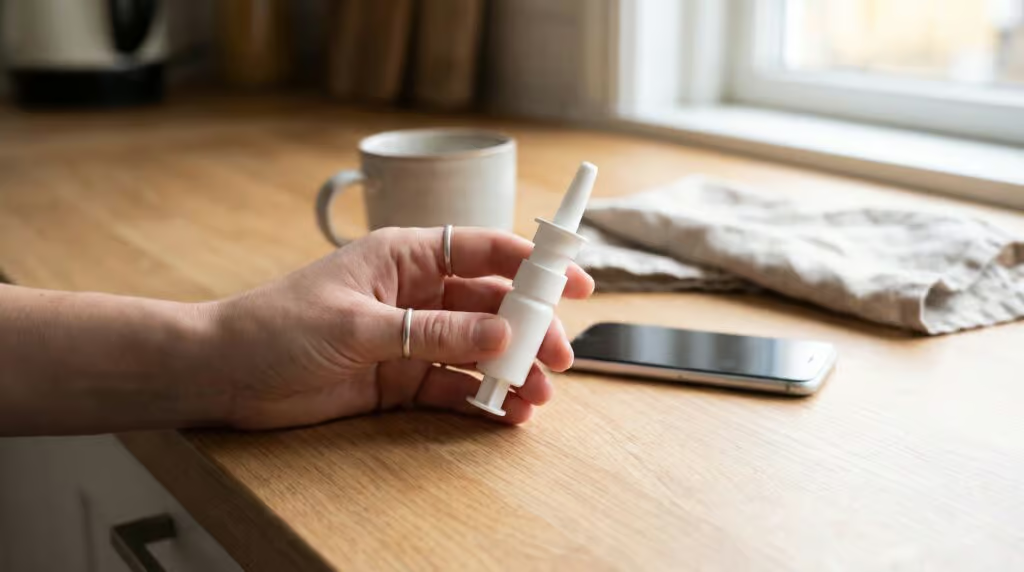
To use naloxone (Narcan) nasal spray, put the nozzle in either nostril, press the plunger firmly, and call 911 right away. If the person does not wake up after 2 to 3 minutes, give another dose and stay with them until help arrives (Narcan Drug Facts label, DailyMed). You can buy it without a prescription, and some health departments and community groups give it out at little or no cost (CDC).
If someone will not wake up, is breathing very slowly, or has blue or gray lips, call 911 now. Give naloxone if you have it (SAMHSA). If you aren’t sure it is an overdose, the CDC says to treat it like one (CDC).
What is naloxone, and what does it do?
Naloxone is a medicine that rapidly reverses an opioid overdose (NIDA). It works by blocking the effects of opioids, and it can bring back normal breathing within 2 to 3 minutes (CDC). Narcan is a brand name for the 4 mg nasal spray (FDA).
Naloxone only works on opioids, such as heroin, fentanyl, and prescription pain pills. It has no effect on someone who does not have opioids in their system (NIDA). Related: how much fentanyl does it take to overdose.
That is why it is safe to give when you are unsure. Naloxone does not cause harm if given to a person who is not having an opioid overdose, so use it even if you don’t know what drugs the person took (SAMHSA).
What are the signs of an opioid overdose?
The main signs of an opioid overdose are being unable to wake up, slow or shallow breathing, discolored lips or nails, and tiny pupils (CDC). Lips or nails may turn blue or purple, or pale, gray, or ashen on darker skin (SAMHSA). You may also hear choking sounds or a gurgling or snoring noise from a person who cannot be woken (CDC). See what happens to your body when you overdose on heroin.
| Sign you see | What to do |
|---|---|
| Will not wake up when you shout their name or rub your knuckles on their chest | Call 911 and give naloxone (SAMHSA) |
| Slow, shallow, or no breathing, or gurgling or snoring sounds | Give naloxone, then give rescue breaths if you can (SAMHSA) |
| Blue, purple, gray, or ashen lips, nails, or skin | Treat it as an overdose, give naloxone, and call 911 (SAMHSA) |
| Very small “pinpoint” pupils that don’t react to light | Treat it as an overdose and call 911 (CDC) |
| Breathing again but still not fully awake | Roll them onto their side (recovery position) and watch their breathing (SAMHSA) |
How do you give Narcan nasal spray, step by step?
Give one spray in the nose, call 911, and repeat every 2 to 3 minutes until the person wakes up. These steps follow the FDA-approved Narcan label and SAMHSA’s toolkit:
- Check for an overdose. The person will not wake up, is very sleepy, or is not breathing well (DailyMed). Try calling their name or rubbing your knuckles on the center of their chest (SAMHSA).
- Give the first dose. Hold the device with your thumb on the bottom of the plunger, put the nozzle into either nostril, and press the plunger firmly (DailyMed).
- Call 911. Call right after the first dose and follow the dispatcher’s instructions (DailyMed; SAMHSA).
- Support their breathing. Give rescue breaths if you can, or follow the 911 operator’s instructions. When breathing returns, roll the person onto their side with the top leg bent (recovery position) (SAMHSA).
- Give a second dose if needed. Wait 2 to 3 minutes after the first dose. If the person does not wake up, keep giving doses every 2 to 3 minutes; the label says it is safe to keep giving doses (DailyMed).
- Stay until help arrives. Stay even if the person wakes up, and give another dose if they become very sleepy again (DailyMed).
How long does naloxone last, and can the overdose come back?
Naloxone works for only 30 to 90 minutes, and many opioids stay in the body longer than that (NIDA). This means overdose symptoms can return after naloxone wears off (SAMHSA).
Stay with the person until emergency help arrives, or for at least 4 hours (CDC). Encourage them to get care from EMS or an emergency room (SAMHSA).
| Time after a dose | What to expect |
|---|---|
| 2 to 3 minutes | Breathing may return; if not, give another dose (CDC) |
| 30 to 90 minutes | Naloxone wears off and the overdose may return (NIDA) |
| At least 4 hours | Stay with the person if help has not arrived (CDC) |
Can you get naloxone without a prescription, and where can you get it free?
Yes, you can get naloxone without a prescription. On March 29, 2023, the FDA approved Narcan 4 mg nasal spray as the first naloxone product for use without a prescription (FDA). Naloxone is now sold over the counter in all 50 states (CDC).
Where to get it:
- Stores: your local pharmacy, convenience store, grocery store, or gas station (CDC).
- Health departments and community groups: these may offer naloxone at little to no cost (CDC). Ask your local health department or visit a harm reduction program (SAMHSA).
- Public places and mail: some programs hand it out through vending machines, street outreach, and local events, and some deliver by mail (SAMHSA).
- Insurance: check whether your plan covers naloxone (CDC).
Will you get in trouble for calling 911 during an overdose?
In most states, Good Samaritan laws may protect the person who is overdosing and the person who called for help from criminal penalties (CDC). These laws give limited immunity, and the details depend on where you live, so check your own state’s law (SAMHSA).
What are the side effects of naloxone?
The main side effect is opioid withdrawal in people who are physically dependent on opioids, and it can start within minutes (NIDA). Withdrawal symptoms may include fever, anxiety, irritability, rapid heart rate, sweating, nausea, vomiting, and tremors (CDC).
These symptoms are uncomfortable but generally not life threatening (SAMHSA). Allergic reactions are rare (NIDA). The Narcan label notes that people may wake up shaking, sweating, nauseated, or angry, and says this is to be expected (DailyMed).
After an overdose, treatment can help. Medicines such as buprenorphine and methadone treat opioid use disorder (SAMHSA); read what medication-assisted treatment is or learn more about heroin.
Sources
- Naloxone DrugFacts, National Institute on Drug Abuse, 2022
- FDA Approves First Over-the-Counter Naloxone Nasal Spray, U.S. Food and Drug Administration, 2023
- Lifesaving Naloxone, Centers for Disease Control and Prevention
- What to Do If You Think Someone Is Overdosing, Centers for Disease Control and Prevention
- Naloxone Frequently Asked Questions, Centers for Disease Control and Prevention
- SAMHSA Overdose Prevention and Response Toolkit, Substance Abuse and Mental Health Services Administration, 2023
- Narcan (naloxone hydrochloride) nasal spray, OTC Drug Facts label, DailyMed, National Library of Medicine
Frequently asked questions
Can naloxone hurt someone who is not overdosing on opioids?
No. Naloxone does not cause harm if given to a person who is not having an opioid overdose (SAMHSA).
Does naloxone work on fentanyl?
Yes. Overdose reversal medicines like naloxone work on opioid overdoses, including those caused by fentanyl (SAMHSA).
How many doses should I give?
Do I still need to call 911 if the person wakes up?
About this article
This article is an educational summary written by the Drug Detox and Rehab editorial team. It is not medical advice. The information above was researched from the listed references.